Thursday, February 19, 2015

Heron Pond in Winter

     It has long been a dream of mine to visit Heron Pond Nature Preserve in the winter.  However, whenever there is a large snow event in southern Illinois, there is a strong incentive to stay indoors.  But I've always wondered how difficult it would be to get into the swamps of the Cache River wetlands in the winter.  This week I finally got my chance.

     After receiving 8-12 inches of snow in southern Illinois on February 16 in the year of 2015, I made it out to explore Heron Pond.  The minor road leading to the preserve from Belknap road was not plowed at all, but other vehicles had traveled the road and compacted the snow.  I was able to make it up the hill to Max Hutchison's house with relative ease in my all-wheel drive Subaru, but the road beyond this point was untrammeled by vehicle or by human foot.

My car at Max's house and the untouched snow on the road to Heron Pond
     I was surprised by this since I was not able to make it out there until the day after the snowstorm.  I guess I figured others had the same foolish endeavor to walk out to see winter work its magic on Heron Pond.  Clearly the locals and other nature lovers were far more sensible than I.  I parked my vehicle in Max’s driveway, checked in with the Hutchison family, and geared up for the hike through the snow.

     Unfortunately, I did not have my cross country skis or snowshoes with me, because the conditions were perfect for their use.  How amazing would it have been to ski out to see a Cypress swamp!  But instead I was left to lift foot after foot into the deep powder and it seemed like forever just to reach the parking lot.

Bridge over the Cache River and the trailhead
     I walked down the hill and over the bridge.  The Cache River was frozen except the spots just after the rock weirs.  These are structures created to slow down the flow of the river, to reduce stream downcutting in the upper reaches of river and to reduce sediment transfer to the lower reaches of the river. 

Rock weirs on the Cache River
     The snow made it easy to see the movements of animals.  I noticed abundant deer and squirrel tracks, and even some mink or otter activity along the river.  I spotted a red-headed woodpecker, brown thrush, some mallards, and an owl that flew off as I approached the boardwalk.  It was marvelous to see such a prized and highly visited spot in such unadulterated beauty.  The solitude made me think I was in a vast wilderness, yet I was just a couple miles from my car.

My tracks on the boardwalk and the virgin powder on the trails and stepping stones
     Max advised me to not go out on the ice, although he admitted that the best time to explore the swamp was when it was frozen.  Since the boardwalk extends into the swamp, I did not feel the need to walk out on the ice, although it did look plenty thick.  Just as I was leaving, the sun poked through the Cypress trees and I got the shot I was looking for. 

Cypress Swamp at Heron Pond Nature Preserve
     On the way back to my vehicle, I reveled in the fact that the only human tracks in the snow were mine.  This is truly a magical place and I was truly elated to experience it in a whole new element.  Once I returned to Max’s house, I had to stop in and what do you know, of course they insisted I stay for chili and cornbread.  Who could turn down such a request?

Chili and cornbread at the Hutchison's

Friday, February 13, 2015

Marcescence


If you are out in the woods this time of year you may have noticed that while most trees have shed their leaves for the season, there are a few trees that have not. These trees have leaves that turn brown, but do not fall off, and instead dangle in the breeze and stand out among the many tree branches that have lost their leaves for the season.
Trees and shrubs in the Beech family (Fagaceae), the Hazelnut family (Corylaceae), and the Witchhazel family (Hamamelidaceae) retain their leaves in the dormant season through a phenomenon called marcescence. Marcescence means “withering but not falling off” and it refers to plants that retain their leaves through the winter. Normally, plants develop an abscission layer, where the connection to the vascular tissue is cut, and this is what causes flower petals, leaves, and fruits to be released from an individual plant. But plants that exhibit marcescence do not develop an abscission layer. This allows the plant to sequester the nutrients trapped in the leaves, instead of allowing them to fall to the forest floor to decay. It is also thought that marcescence evolved to deter herbivory. This makes sense since marcescence tends to only occur on young trees. Larger trees shed their leaves since herbivores cannot reach them.
Regardless of the reason, marscesence makes it easy to identify young beech trees in the forest, as demonstrated by the photo.

Thursday, February 12, 2015

Winter Tree ID basics


Woody plants for the most part refers to trees and shrubs, and even though woody plants are dormant this time of year, they can still be identified. While most people find winter tree ID to be difficult, there are several characteristics that make it possible.
The first thing to notice is the leaf arrangement along the stem, which can be alternate, opposite, or whorled. “But it’s winter and there are no leaves!” you might exclaim. Well, there are clues you can look at to determine this. The process by which a tree sheds its leaves is termed abscission, which is a word that comes from Latin and means “to cut away.” When a leaf detaches from the branch, a scar remains visible at the point of attachment.
Observe the leaf scars on the twig in the photo. They are arranged in pairs or “opposite” from each other. This makes identification easy because there are not many woody plants that have opposite leaves and you can remember them with this simple mnemonic device: MAD Cap Buck Horse.
“MAD” stands for maple, ash, and dogwood. All species of maples (Acer spp.), ashes (Fraxinus spp.), and dogwoods (Cornus spp.) have opposite leaves, except for the appropriately named alternate-leaved dogwood (Cornus alternifolia). “Cap” stand for Caprifoliaceae, which is the honeysuckle family. All species in this family have opposite leaves and in Illinois the woody species include honeysuckle (Diervilla spp. and Lonicera spp.), elderberry (Sambucus spp.), coralberry (Symphoricarpos spp.), and different species in the genus Viburnum. “Buck” stands for buckeye (Aesculus spp.) and “Horse” stands for Horse Chestnut (Aesculus hippocastanum). There are very few possible exceptions, and most of these only look opposite (but are really whorled). Despite the exceptions, the vast majority of the time a woody plant with opposite leaves will be one of these options. The twig in this photo is Horse Chestnut, a non-native species that has been commonly planted in the US.
Also present in this photo, on the surface of the leaf scars, are bundle scars. This marks the severed connection of the vascular bundles that transport food and water between the twig and the leaf. This species has seven distinct bundle scars arranged in a U-shaped pattern. In fact, the bundle scar is shaped like a horseshoe, which may be where it gets its name.
Other features visible along the twig are dots called lenticels. Lenticels are present on some species and they are small openings that allow for gas exchange between the twig and the atmosphere. Near the left end of the twig in the photo is a group of rings that are called bud scale scars. This indicates the end of the previous season’s growth. You can actually determine the age of young trees by looking at the bud scale scars.
Lastly are the buds. Horse Chestnut has very large and resinous buds. Buds at the end of the branch are called terminal buds and buds that emerge from the side of the twig are called lateral buds. This marks the end of the current season’s growth and is where new twig growth will start from during the next growing season.
Opposite leaves, seven bundle scars, broad leaf scars at least ¼ inch across, with large (up to one inch) sticky buds keys out to Horse Chestnut.
Now that wasn’t that hard was it?

Tuesday, December 2, 2014

List of Plant Resources

     There are many great field guides out there and excellent websites for plant identification, but finding useful ones can be difficult, depending on where you live.  Here is a list of resources that I find useful.  This list is particularly applicable to the southern Illinois region, but includes other regions as well.  If you have any suggestions for the list, please leave them in the comments section.


Plants Resources for Southern Illinois

Field Guides
Illinois
  • The Flora of Illinois by Robert Mohlenbrock.  Southern Illinois Press.  4th ed. 2014.
  • Illustrated Flora of Illinois series by Robert Mohlenbrock.  Southern Illinois Press.  Various years.
  • Forest Trees of Illinois by Robert Mohlenbrock.  Illinois Department of Natural Resources.  2006.
  • Trees of Illinois by Linda Kershaw. Lone Pine. 2007.
  • Trees of Illinois by Stan Tekiela. Adventure Publications, Inc. 2006.
  • Illinois Wildflowers by Don Kurz.  Cloudland.net publishing.  2004.
  • Plants of the Chicago Region by Floyd Swink and Gerald Wilhelm. 
  • Plant Communities of Southern Illinois by John Voigt and Robert Mohlenbrock.  Southern Illinois Press.  1964.
  • Flora of Illinois by George Jones, 3rd edition.  American Midland Naturalist.  1963.
  • Flora of Southern Illinois by by Robert Mohlenbrock and John Voigt.  Southern Illinois Press.  1959.

Indiana
  • Indiana Wildflowers by Kay Yatskievych.  Indiana University Press.  2000.

Iowa
  • Wildflowers of Iowa Woodlands by Sylvan Runkel and Alvin Bull.  University of Iowa Press.  1979.
  • Wildflowers and Other Plants of Iowa Wetlands by Sylvan Runkel and Dean Roosa.  University of Iowa Press.  1999.
  • Wildflowers of the Tallgrass Prairie by Sylvan Runkel and Dean Roosa.  University of Iowa Press.  1989.

Kentucky
  • Plant Life of Kentucky by Ronald Jones.  The University Press of Kentucky.  2005.
  • Wildflowers and Ferns of Kentucky by Thomas Barnes and S. Wilson Francis.  The University Press of Kentucky.  2004.

Missouri
  • The Flora of Missouri volume 1 by George Yatskievych.  Missouri Botanical Garden Press. 1999.
  • The Flora of Missouri volume 2 by George Yatskievych.  Missouri Botanical Garden Press. 2006.
  • The Flora of Missouri volume 3 by George Yatskievych.  Missouri Botanical Garden Press. 2014.
  • Trees of Missouri by Don Kurz.  Missouri Department of Conservation. 2003.
  • Shrubs and Woody Vines of Missouri by Don Kurz.  Missouri Department of Conservation. 1997.
  • A Key to Missouri Trees in Winter by Jerry Cliburn & Ginny Wallace.  Missouri Department of Conservation. 1990.
  • Ozark Wildflowers by Don Kurz.  Morris Book Publishing.  1999.
  • Missouri Wildflowers by Edgar Denison, 6th edition.  Missouri Department of Conservation.  2008.

General
  • Newcomb’s Wildflower Guide by Lawrence Newcomb.  Little, Brown and Company.  1977.
  • Wildflowers by Roger Tory Peterson and Margaret McKenny.  Houghton Mifflin Company.  1968.
  • Wildflowers of Tennessee, the Ohio Valley, and the Southern Appalachians by Dennis Horn and Tavia Cathcart.  Lone pine Publishing.  2005.
  • Vascular Flora of the Carolinas by Albert Radford et. Al. University of North Carolina Press.  1968.
  • Wildflowers of Wisconsin and the Great Lakes Region: A Comprehensive Field Guide by Merel Black and Emmet Judziewicz. Univerity of Wisconsin Press, 2009.
  • Wildflowers in the Field and Forest: A Field Guide to the Northeastern United States by Steven Clements and Carol Gracie Oxford University Press, 2006.
  • The New Britton & Brown Illustrated Flora of the Northeastern States and Adjacent Canada by Henry A. Gleason.  NY Botanical Garden, 1968.
  • Manual of Vascular Plants of the Northeastern States and Adjacent Canada by Gleason and Cronquist. NY Botanical Garden. Reprint 1991.
  • Manual of the Grasses of the United States by A.S. Hitchcock. Dover edition, 1971
  • Field Guide to Native Oak Species of Eastern North America by Stein, Binion & Acciavatti.  USDA, 2003.

Websites


Wednesday, May 21, 2014

Rare Plants and Northwestern Illinois Nature Preserves

     You know you have a cool job when you do the same thing on your day off as you do when working. Such is the case with many botanist photographers and I am no exception.  Recently I went over to the northwestern portion of Illinois to take a look around at the natural areas there and to photograph some rare plants in flower.  The first site for the day was Sentinel Nature Preserve in Mississippi Palisades State Park, in Carroll County.  I met my mentor and former IDNR heritage biologist for this region, Randy Nyboer, and hoped to see the display of Trilliums the park is known for.  We were a little late for the peak bloom, and that morning it got so cold it even snowed a little, so the wildflowers looked a little beat up.  Plus some large red oaks had fallen on some of the large patches so photographing the flowers was difficult, but nature is chaos and the scene was still beautiful.
Large-flowered Trillium (Trillium grandiflorum)
     This site is one of only a few in Illinois that has the Ill-scented Trillium (Trillium erectum).  Like most flowers that are maroon, this plant has a foul smelling odor that attracts pollinators like flies, ants, and beetles.
 Ill-scented Trillium (Trillium erectum)
     We continued on up the trail to find more rare plants I have not seen or photographed before.  I expected to find Jeweled Shooting Star (Dodecatheon amethystinum) in the forest near the cliff edge.  There are three species of Shooting Star (Dodecatheon spp.) in Illinois.  The common one is called Shooting Star (Dodecatheon meadia) and can be found throughout the state in prairies and woodlands.  There is a rare one in southern Illinois called French's Shooting Star (Dodecatheon frenchii) and the Jeweled Shooting Star in Illinois is restricted to the northwestern part of the state.
Jeweled Shooting Star (Dodecatheon amethystinum)
     Near the Jeweled Shooting Star is the prominent feature of the park and the nature preserve.  The palisade is a rock cleavage that boldly projects itself against the backdrop of the Mississippi River.  The rock is dolomite, a type of limestone, and harbors some obligate species like Purple Cliffbrake Fern (Pellaea atropurpurea) and Baby Lip Fern (Cheilanthes feei).
The Mississippi Palisade and Purple Cliffbrake Fern (Pellaea atropurpurea)
     Another area we looked at contained a hill prairie that was supposed to be of Illinois Natural Areas Inventory (INAI) quality.  Unfortunately this area had seen too much trampling and abuse to be considered high quality, at least the vast majority of it anyway.  We did find a small patch of Bastard Toadflax (Comandra umbellata) and Hoary Puccoon (Lithospermum canescens).  The area also provided for a wonderful panoramic view with the Mississippi River in the background.
Hill Prairie above Mississippi River
 
Your blogger with the Mississippi River in the background
     The last species of note for me at this site was a fern that I had not seen before.  I have observed almost all of the species of ferns in Illinois and so I am very interested in learning the few I had not yet seen.  This is why Randy gave me a weird look when I was so excited to observe Ostrich Fern (Matteuccia struthiopteri).
Ostrich Fern (Matteuccia struthiopteri)
     We took a brief look for any Yellow Lady Slippers (Cypripedium pubescens) but most of them near the trail had long since been poached.  We accidentally forgot all about checking on Canada Violet (Viola canadensis) and went back to our vehicles.
     Not wanting to return to the office work we were planning to do, we decided to continue on to another high quality nature preserve.  We drove a short distance to Ayers Sand Prairie Nature Preserve, also in Carroll County, where we could observe plants that are adapted to sand.
Ayers Sand Prairie Nature Preserve and Dwarf Dandelion (Krigia virginica)
     Dwarf Dandelion (Krigia virginica) is something I had not seen before and so while probably not very exciting to most botanists, it was exciting to me.  We walked around to see what species were in full glorious bloom and I noticed another sand species I had not observed before, mostly because I don't regularly botanize sand communities in the counties I wander.
     In the Scrophullariaceae, Blue Toadflax (Nuttallanthus canadensis) is named because the leaves of the plants resemble those in the Linum genus, which are called Wild Flax.  Toads were also believed to seek refuge beneath the branches of these plants, hence the name "toadflax."  Sounds like a stretch to me but still a neat plant to observe.
Blue Toadflax (Nuttallanthus canadensis)
     The most exciting observation here was seeing the mass bloom of the Bird's-foot Violet (Viola pedata).  I had seen plenty of this one before, but never in such great abundance.
Bird's-foot Violet (Viola pedata)
     If it were a nice day we could have hoped to see some Ornate Box Turtles (Terrapene ornata), but it was still cold and rainy so they were hiding.  The rain also caused us to head back to the vehicles and call it a day.  But I rarely make it over to this part of the state and I wanted to see more.  I remembered seeing a sign for Apple River Canyon State Park on my drive over so I decided to return home the way I came so that I could take the 6-mile one-way drive into the canyon.
Apple River Canyon State Park, Jo Daviess County, Illinois
     I specifically wanted to see the Bird's-eye Primrose (Primula mistassinnica) and I knew that it grew on the moist cliffs along the Apple River.  The area was easy to find and there was a parking lot directly across from it.  I looked around on the cliffs from the other side of the Apple River but I didn't see any purple flowers and the river looked deep so I wandered upstream to photograph the canyon.
     Then I remembered I had my binoculars so I returned to my car and when I scanned the cliff again, I saw clumps of little purple flowers, mostly high up on the cliff.  I looked at the deep water in front of me and thought, getting wet is not going to stop me from going over there and getting a photograph!  However, I was able to find a spot downstream that was wide and was able to wade in my knee boots to the other side without getting wet.  But all the good specimens were beyond reach with my camera!  I photographed one here and then one there, but couldn't find any to my liking.
     I returned to the spot I started at and went the other way and managed to find a suspended ledge I could scramble up on and there I found exactly what I was looking for.  Several very happy clumps of blooming plants.  I smiled in satisfaction and vowed to return later in the summer when another rare plant would be in flower on this very same cliff, a plant known as Sullivantia (Sullivantia sullivantii).
   
Bird's-eye Primrose (Primula mistassinnica)
     It was another great day of botanizing in the wonderful state of Illinois.


Saturday, March 22, 2014

The Venomous Snakes of Illinois

     People often erroneously refer to snakes as “poisonous,” but the proper technical term is venomous. The difference is that poison is ingested and venom is injected. If the toxin is from eating or touching the organism, then it is poison. If the toxin is from a bite by an animal, then it is venom.
     The Timber Rattlesnake (Crotalus horridus) is one of four species of venomous snakes in Illinois. The name “crotalus” comes from the Greek “krotalon” and means “a rattle,” while “horridus” means “dreadful.” However, these beautiful creatures are not to be feared and people are usually surprised to learn that they are actually very docile animals. They rarely need to strike since they can warn any perceived threats by shaking their rattles.

     A rattlesnake adds a new segment to its rattle every time it sheds. The rattle is completely hollow and there is nothing inside; rather the rattling sound comes from the ends of the rattle segments hitting one another when the snake moves it tail rapidly.
Some snakes have weak tail muscles and are unable to move their tails fast enough to make a rattle sound. This seemingly deleterious condition is actually advantageous in the human dominated landscape, and is a great example of evolution at play.
     If someone wants to find a rattlesnake and kill it or remove it from nature, it is a lot easier if they are given an audible clue, as rattlesnakes are very cryptic and secretive and can be difficult to locate in the wild. People who love to kill snakes are perhaps outrivaled only by those who want to collect them for the pet trade. In some places still, people have events in which the purpose is to find and kill as many rattlesnakes as possible.
     Rattlesnakes that cannot produce an audible rattle when threatened are not heard and therefore not found and killed. In South Dakota for example, this is leading to populations in which the majority of the rattlesnakes cannot rattle. The environment has selected the favorable trait, for better or for worse. The media would like to suggest it is for worse, claiming the snakes are now silent killers and should be feared. But conservationists hope this allows the species to rebound, and although the long term effects of this are largely unknown, it is a case of evolutionary biology in progress.
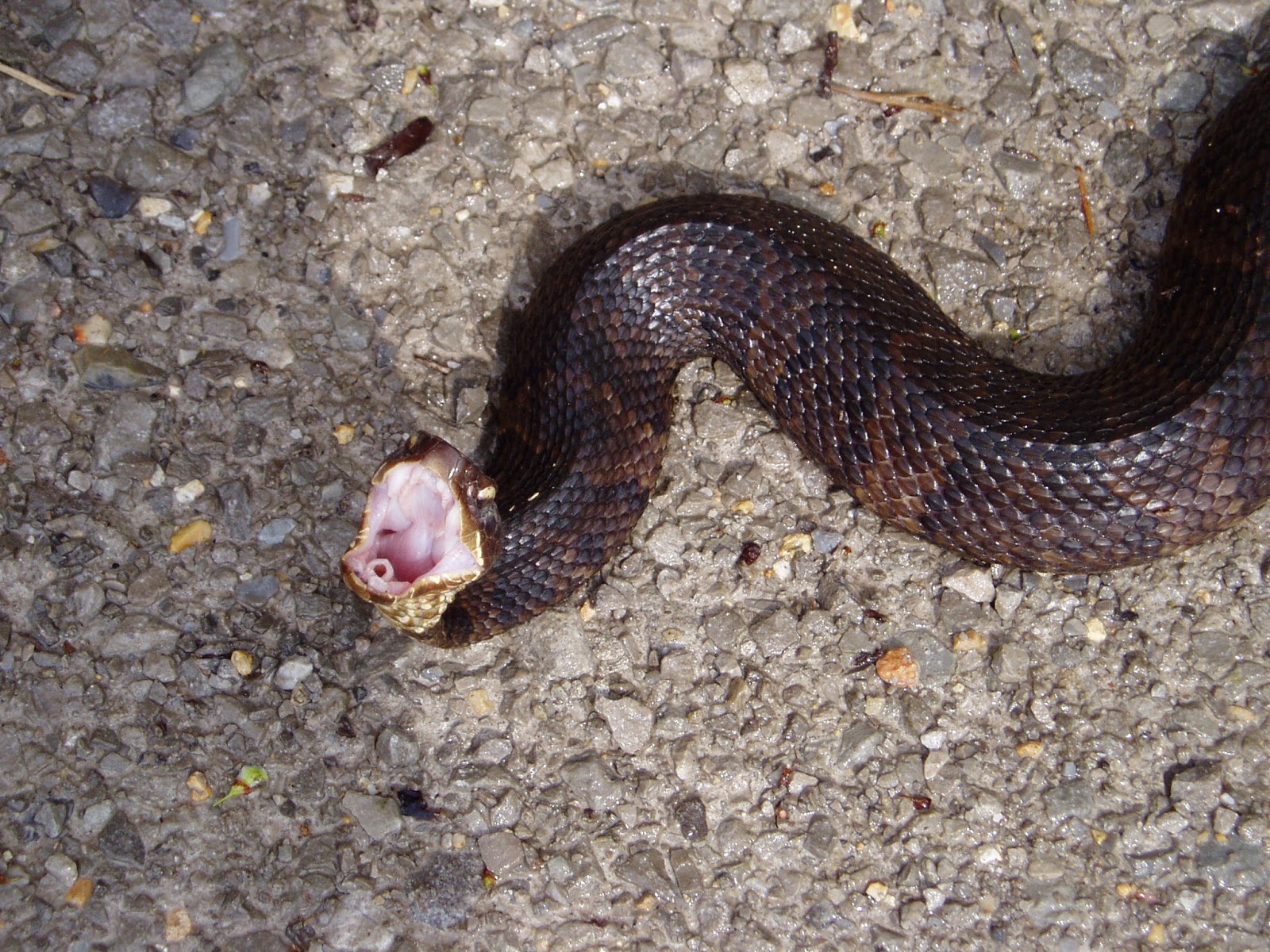
     Cottonmouths (Agkistrodon piscivorous) are very restricted in Illinois and only occur near large wetlands, mostly in Jackson, Johnson, and Union counties in southern Illinois. “Agkistrodon” means “hooked tooth” and “piscivorous” means “fish-eater.” These snakes are also sometimes called water moccasins, but that is a misleading name. People often use it whenever they see a snake in the water. However, all snakes swim and there are 5 different species of watersnakes (Nerodia sp.) in Illinois which can look similar and are much more likely to be encountered.

     One place where cottonmouths can be seen in abundance is at LaRue Pine Hills Ecological Area in Union County, Illinois. On any given day in the spring and fall, many can be seen crossing the gravel path, known as the “snake road.” Called the annual snake migration, many animals, not just snakes, move from the steep upland woods across the gravel road to the vast floodplain swamp. Due to the local tradition of driving this road to run over snakes, the road is now closed for two months in the spring and fall to allow for this fascinating wonder of nature. In fact, 65% of the reptiles and amphibians that occur in Illinois can be found at this single 2811-acre site. All collecting is prohibited.
   
     Cottonmouths have very whitish mouths that they like to open as a defense posture. Some people claim to have been charged by this species of snake and this perceived aggression has led to the unfortunate phrase, “the only good snake is a dead snake.” In my experience, if you leave a snake alone, it will leave you alone. There is a reason why the vast majority of snake bites involve these things; young men, alcohol, and getting bitten on the hand.


     In actuality, every organism has its place in the food chain, every organism has inherent biological value, and every organism has the right to exist and prosper. However, humans tend to play favorites and snakes are rarely on the list, although they should be, mostly because they are excellent at rodent control.
So be kind to snakes, even the venomous ones.

     Although seldom seen, the most common of the four venomous snakes in Illinois is the copperhead (Agkistrodon contortrix). Despite being morphologically variable, their cryptic appearance allows them to hide extremely well. In fact, one time while in the company of Southern Illinois University Zoology professor Matt Whiles, he pointed to an area in the front of his yard, and mentioned that he had seen copperheads there in the leaves. We looked closer and then spotted a copperhead hiding in the leaves.
     Another time while leading a group in nature, I noticed a juvenile copperhead coiled up among the base of a cliff after most of the group has walked right by it. Funny story, at the same time exactly one week later, I told another group about seeing a copperhead in that spot the week before and when we got there, the snake was in the exact same place!

     “Agkistrodon” means “hooked tooth” and “contortrix” means “twisted” or “intricate”, referring to the dorsal pattern on this species. It is very useful to notice this pattern in order to distinguish this species from watersnakes, such as the northern watersnake (Nerodia sipedon). Notice that the dark portions of the bands are shaped like an hourglass, or Hersey’s kisses, whereas on the watersnake, the pattern is the opposite. Of course there are other more subtle differences. All venomous snakes have elliptical pupils and nonvenomous snakes have round pupils. Venomous snakes also have triangular heads and although this may seem like a minor feature, once you observe a lot of snakes, this becomes readily apparent. Notice whether the head is the same size to slightly larger than the body of the snake, or if the base of the head is noticeably larger than the body of the snake.

     One of the situations in which copperheads are frequently found is in the wood pile in rural areas. They are a social species and are known to hibernate with other venomous snakes like timber rattlesnakes, as well as nonvenomous snakes, such as black rat snakes. Their bite is rarely fatal and most individuals are bitten while attempting to kill the snake. It’s best to just leave them alone.

     The last venomous snake in Illinois to be presented on this page is the rarest of the four. The eastern massasauga (Sistrurus catenatus) is type of rattlesnake native to the once expansive prairie of Illinois. Most of this prairie was wet prairie and it has been converted to agriculture. Now most of the massasaugas are gone. However, scattered populations can still be found in extreme northern Illinois and as far south as Clinton County. They are listed as state endangered in Illinois and are a candidate for federal listing.
     “Sistrurus” comes from two Latin words which translate to "rattle tail.” The epithet “catenatus” means “chained”, describing the dorsal pattern. The word "massasauga" is believed to mean “great river mouth” in the Chippewa language and it refers to swampy habitats found near the mouth of rivers in which these snakes can be found. Also called prairie rattlesnakes, this species spends a lot of time utilizing burrows created by crayfish. They come out of the ground in spring, covered in mud, and bask in the grass on warm sunny days, like the individual in the photo.

Tuesday, January 7, 2014

Little Grand Canyon Ecological Area, Jackson County, Illinois

     This strenuous hike will challenge even the most adventurous hiker.  In southern Jackson County, the Little Grand Canyon displays the most unique sandstone ravines in the state.  The trail is a 4-mile loop that is great from either direction from the parking lot.  Descending the trail at the north end, you will walk through a small pine stand and slowly hike down the ridge to an overlook.  After you round the corner, look for rue anemone, pussytoes, false dandelion, bee-balm, and other dry woodland plants.  Many rare plants exist at this site so please stay on the trail. 
Krigia biflora - False Dandelion
     The trail winds its way to a steep sandstone ravine that will take you to the bottom of the canyon.  Rocks steps have been created in the sandstone and are easy to follow.  Flowing water often occurs in the sandstone chute, so extreme caution should be exercised.  As you make your way into the canyon, look for dutchman’s breeches, toothwort, pale corydalis, squirrel corn, and spring beauty.
Trail into the Little Grand Canyon
     Some very interesting plants grow in the natural area.  During the Illinoian glaciation over 100,000 years ago, plants adapted to northern climates flourished here and when the glaciers retreated, these “glacial relic” species persisted in moist, shaded, north-facing, sandstone ravines like the Little Grand Canyon.  The characteristic example of this is bishop’s cap, and the tiny snowflake-like flowers can be seen in flowering spikes covering the sides of the cliffs along the creek.  Other relic species include partridge berry, shining clubmoss, and sphagnum moss.
Mitella diphylla - Bishop's Cap
Mitchella repens - Partrige-berry
     In the floodplain area at the base of the ravine is a rich display of spring wildflowers like liverleaf, bellwort, white trillium, celandine poppy, bloodroot, as well as many fern species.  
Hepatica acutiloba - Liverleaf
Stylophorum diphyllum - Celandine Poppy and Trillum flexipes - White Trillium
     Blue cohosh, Forbe’s saxifrage, doll’s eyes, dwarf phacelia, and wild leeks are uncommon plants that call this area home.  Flowering shrubs include pawpaw, redbud, and flowering dogwood.  At least one orchid has been seen along the trail and venomous snakes are known to inhabit the area. 
Saxifraga forbesii - Forbe's Saxifrage and Caulophyllum thalictroides - Blue Cohosh
Allium triccocum - Wild Leek
     The trailhead is located south of Murphysboro.  From Highway 127, follow Orchard Hill Road west to Hickory Ridge Road.  Go straight (west) 7 miles to the entrance road to the site.
The Little Grand Canyon